
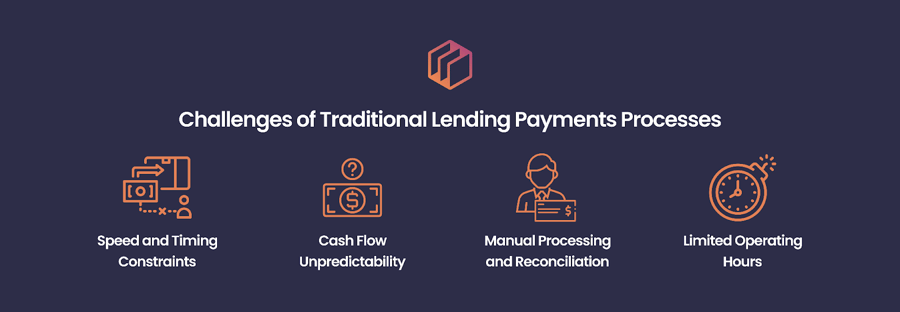
While lending technology has advanced significantly across origination, underwriting and servicing platforms, payment processing has remained largely unchanged, creating a disconnect between sophisticated loan management systems and outdated money movement capabilities.
This disconnect has real consequences. Borrowers accustomed to instant digital experiences encounter friction when accessing loan funds or making repayments. Lenders struggle with cash flow unpredictability, manual reconciliation processes and operational inefficiencies that impact their ability to scale and compete effectively.
The solution for lenders lies in modernizing payment infrastructure through instant payments.
Pay by Bank: An Opportunity for Growth
Pay by bank represents an evolution in how borrowers interact with loan payments through modern, real-time banking interfaces that enhance traditional A2A transfers. While most loans are already disbursed to bank accounts and repaid through bank transfers, current lending processes create significant friction that modern pay-by-bank solutions can address.
The lending industry faces substantial challenges in meeting borrower expectations. Recent data shows loan application completion rates have dropped dramatically from 76% in 2021 to 57% in 2024, with borrowers likely moving to competitors that offer more streamlined experiences. The same data also reveals only 65% of banks offer mobile-friendly loan applications, and just 57% allow customers to complete the entire application online. This friction in the lending process is damaging customer experience and leading borrowers to abandon applications.
Modern pay-by-bank solutions address these pain points by offering instant payment capabilities that borrowers clearly value. Research shows 73% of consumers receiving loan disbursements are willing to pay a fee to receive funds instantly, with this willingness extending across loan types: 61% for personal loans and 59% for debt consolidation loans. Despite this demand, the market opportunity remains largely untapped, with instant loan disbursements reaching only 39% of recipients as of July 2024.
The embedded lending space, where pay-by-bank solutions can have the most impact, shows particular promise for improvement. One study found 88% of embedded lending users reported friction compared to 58% for traditional lending, presenting a clear opportunity for lenders who can provide seamless, integrated payment experiences. In this study, 17% of consumers used embedded lending products while a separate study found 43% of consumers expressed interest in switching to providers that offer embedded lending, revealing a clear market demand for better integrated payment solutions.
For alternative lenders, Buy Now, Pay Later (BNPL) providers and LMS platforms, implementing modern pay-by-bank solutions enables them to capitalize on borrowers' willingness to pay premium fees for instant access while differentiating themselves in an increasingly competitive market where speed and user experience drive customer acquisition and retention.
Demystifying Instant Payments: The Technology Behind Modern Money Movement
Instant payments represent a fundamental shift from traditional batch processing to real-time, irrevocable fund transfers that occur 24 hours a day, 7days a week, and 365 days a year. Unlike conventional ACH transfers that settle in 1-3 business days or wire transfers that require manual intervention and operate only during banking hours, instant payments process within seconds of initiation.
Two primary networks facilitate instant payments in the United States: the RTP® Network operated by The Clearing House and the FedNow® Service managed by the Federal Reserve. Both networks utilize modern messaging standards and APIs that enable immediate funds verification, real-time processing and comprehensive data transmission with each transaction.
Instant payments differ fundamentally from other payment methods in their speed, availability, and cost structure. While ACH transfers process in batches at predetermined times, instant payments occur individually and within seconds. Wire transfers require manual processing and significant fees, but instant payments can be automated and typically cost a fraction of wire transfer fees. Unlike credit card payments that move through intermediary networks, instant payments transfer funds directly between bank accounts, reducing processing costs and eliminating chargeback risks.
The fundamental advantage of instant payments lies in their irrevocable nature and rich data capabilities. Each payment carries extensive remittance data—up to 140 characters of information that can include loan account numbers, payment references and other critical details for automated reconciliation. This eliminates much of the manual work traditionally required to match payments to specific loan accounts. Instant payments can also provide immediate settlement certainty that funds will not be returned due to insufficient funds or other issues that plague traditional ACH transactions.
RTP for lending applications proves particularly valuable in commercial scenarios due to its higher per-transaction limits, which can accommodate the larger loan amounts typical in business lending environments. The RTP network's established infrastructure and participation from major financial institutions makes it well-suited for handling substantial commercial transactions that may exceed the limits of other payment networks.
Conversely, FedNow for lenders expands access to instant payment capabilities across institutions of all sizes, with particular strength in reaching smaller community banks and credit unions that may not have had previous access to real-time payment networks. FedNow's broader institutional coverage enables lenders to serve borrowers who bank with smaller financial institutions, while its competitive transaction limits make it effective for personal loans, smaller commercial transactions, and other lending scenarios where accessibility across diverse banking relationships takes precedence over maximum transaction size.
If you want a deeper look at how pay by bank works in lending, including real-world use cases, implementation considerations, and the operational impact across the loan lifecycle, explore our in-depth guide: