

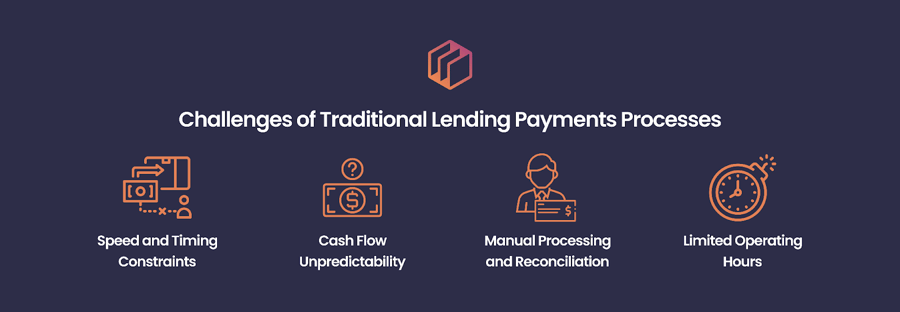
Traditional lending payment processes create multiple friction points that impact both operational efficiency and borrower satisfaction. These challenges have persisted despite significant technological advances in other areas of lending operations, creating clear opportunities for companies that embrace modern payment infrastructure.
Challenges of Traditional Lending Payments
Speed and timing constraints force lenders to operate within restrictive timeframes that can often conflict with borrower needs and market opportunities.
- ACH transfers initiated on Friday may not settle until Tuesday, creating extended periods where borrowers cannot access approved funds.
- Wire transfers, while faster, require manual processing during banking hours and come with substantial fees that make them impractical for many loan scenarios.
These timing constraints particularly impact time-sensitive lending situations including emergency loans, bridge financing and other urgent funding needs that cannot wait for traditional payment processing timelines. This unpredictability makes it nearly impossible to provide borrowers with precise timelines for fund availability or to optimize internal cash management processes.
Manual processing and reconciliation burdens consume significant resources across lending operations.
- Staff must manually match incoming payments to specific loan accounts, often working with limited remittance data that makes accurate attribution challenging.
- Wire transfers require individual manual setup for each transaction, creating bottlenecks in high-volume situations.
- When payments fail or encounter issues, staff must research problems manually, contact borrowers and initiate resolution processes that can take days or weeks to complete.
The constraint of limited operating hours creates artificial restrictions on when lending operations can complete fund transfers. Borrowers who need access to funds over weekends or holidays must wait until banking systems resume operation, potentially missing critical business opportunities or facing emergency funding gaps.
This limitation puts lenders at a competitive disadvantage compared to alternative funding sources that can operate with greater flexibility.
Modernize Lending Payments With Pay by Bank
Traditional payment constraints don’t have to be a permanent cost of doing business. Pay by bank payments give lenders a faster, more predictable, and more automated way to move money—helping teams reduce operational friction while delivering a better borrower experience.
If you want a deeper look at how pay by bank works in lending, including real-world use cases, implementation considerations, and the operational impact across the loan lifecycle, explore our in-depth guide: